Emax veneers — get a perfect smile in Warsaw
A ceramic plate the thickness of a contact lens can hide cracks, pigmentation, gaps between teeth and small irregularities without rough preparation. These are veneers — microprostheses that are fixed to the outer surface of the tooth using modern adhesive technology. Astra Dent specialists create the shape of the future smile in digital planning (DSD), conduct a 3D scan with an intraoral scanner and manufacture overlays in a CAD/CAM system with accuracy down to microns. The patient immediately sees a 3D model of the result, and the doctor controls the thickness of the enamel treatment to hundredths of a millimeter.
Why do patients choose Astra Dent Warsaw for veneers?
Aesthetic dentistry requires jewelry precision: the success of the restoration depends on the doctor’s skill, planning and technical support. Veneers are installed in the area that attracts the most attention. Even a small error in shape, color or symmetry is noticed immediately. Therefore, the team, experience and work protocol come to the fore.
Advantages of installing Emax veneers at Astra Dent:
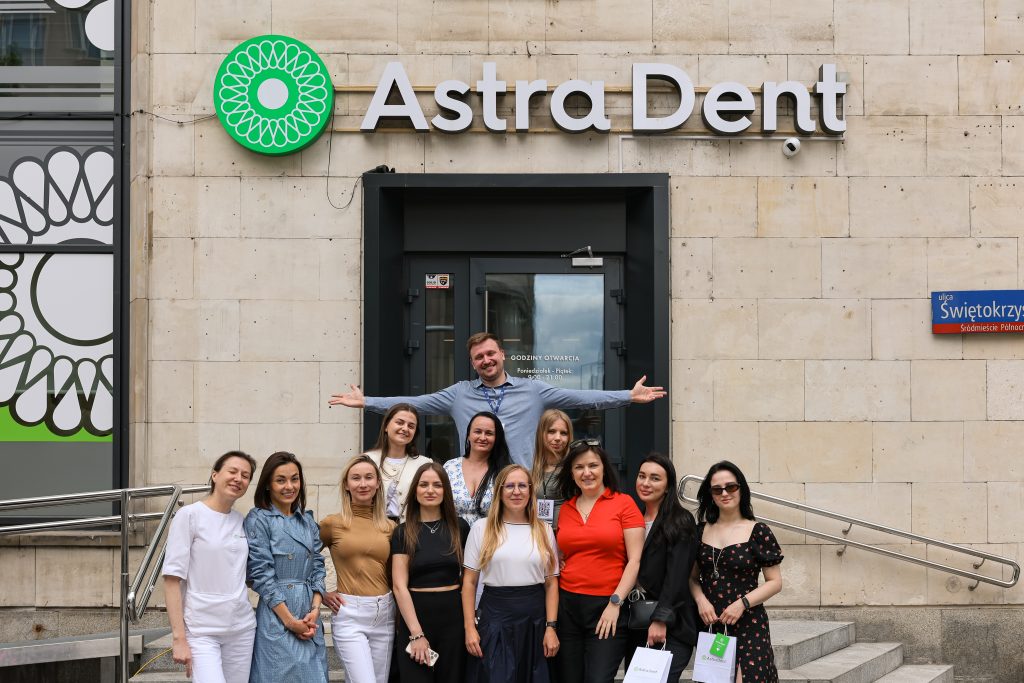
- Experienced specialists. The dental center is staffed by doctors who have been working with microprosthetics in the frontal area for over 15 years, have undergone internships in Europe and use a microscope at each stage of the intervention. They precisely control the preparation border, enamel microcracks and the quality of fixation.
- Digital smile modeling. Before starting work, the shape of a new smile is created in Digital Smile Design. The model is formed based on a photo of the face, a digital impression and parameters of the chewing function, which allows taking into account aesthetics and biomechanics.
- Cooperation with premium laboratories. Veneers are manufactured in certified dental laboratories specializing in Emax prosthetics. This ensures perfect marginal adaptation and color reproduction, taking into account transparency and depth of shade.
- Professional support after installation. After the veneers are fixed, specialists conduct observations, provide recommendations for care, polishing and regular check-ups of the fixation. They conduct a control photodiagnostics after 6 months to assess the stability of color and occlusion.
The combination of individual planning, technical accuracy and clinical support reduces the risk of complications and ensures the durability of the restoration.
What are Emax veneers?
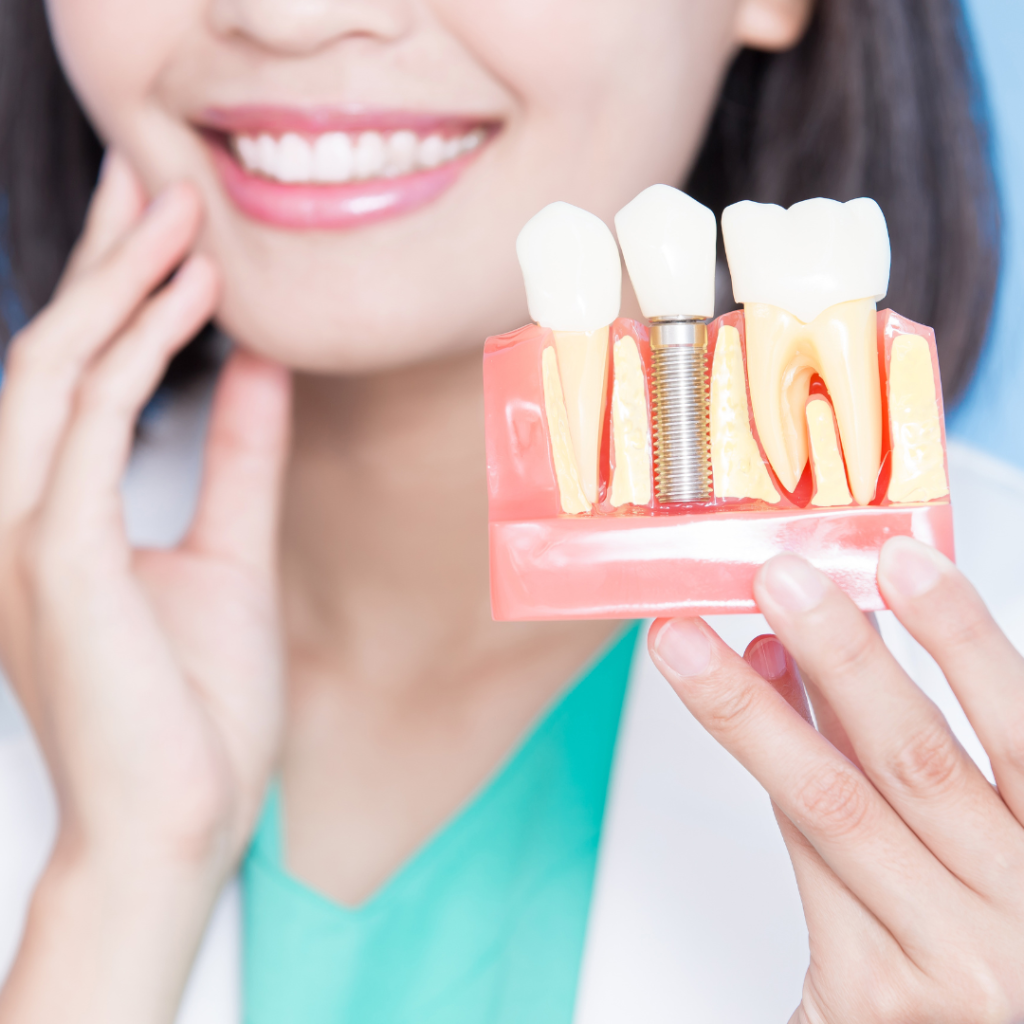
Ceramic overlays made of Emax material are thin microprostheses that are fixed to the front surface of the tooth to restore the shape, color and symmetry of the smile. Unlike zirconium solutions, they preserve more enamel and create a visual effect close to a living tooth.
What does Emax technology consist of and how does it differ from other ceramics:
- Material. Lithium disilicate glass ceramic is created by pressing at high temperatures. It has a crystalline structure with a content of more than 70% crystals, providing a bending strength of more than 400 MPa. The special microstructure gives the material mechanical stability and a high level of light transmission.
- Thickness. Veneers are made with a thickness of 0.3 to 0.5 mm. This allows us to avoid invasive preparation: enamel polishing without removing tissues is sufficient.
- Adhesion. Fixation is performed using a multi-level technology: acid etching with 5% HF gel, silane application, fixation with composite cement with light polymerization. This ensures a reliable micromechanical connection with enamel and tightness of marginal adaptation.
- Aesthetics. The material has high transparency and is available in a wide range of shades — from neutral A1, A2 to bright white shades of the Bleach group. Visual depth is achieved without additional staining or multi-layer application.
- Biocompatibility. Emax does not irritate the mucous membrane and does not react with saliva or other materials in the oral cavity.
In practice, the doctor gets the opportunity to work with a transparent, stable material that transmits the color of dentin well, and the patient gets a long-term result with minimal intervention.
When should veneers be installed?
Veneers are an individually selected technique that is used in cases where the preserved tooth structure allows microprosthetics without full processing. The feasibility of the procedure is determined on the basis of clinical diagnostics, which is carried out using intraoral photography, bite analysis and digital scanning.
Installation of veneers is effective where it is necessary to correct the appearance of the teeth:
- Darkening, fluorosis, uneven color of the teeth. In cases where the tooth tissues lose transparency or have a spotty structure, for example, with fluorosis or the consequences of drug intoxication, veneers completely cover the defect without replacing the crown part.
- Cracks, chips, abrasion. Minor enamel defects, loss of tooth angle or reduction in height due to bruxism are compensated by a thin overlay, which restores the anatomical shape and reduces further load on the tooth.
- Gaps between the teeth (diastemas). Veneers delicately correct gaps without orthodontic treatment. Onlays expand the clinical crown, preserving the harmony of the smile.
- Correction of the shape of the teeth. In case of congenital or acquired disproportions, for example, pin-shaped teeth or an uneven cutting line, ceramics create a symmetrical and harmonious contour without excessive intervention.
- Comprehensive aesthetic transformation. In cases of total smile restyling, veneers are applied in several segments at once, taking into account the color, width of the smile, face shape and bite.
The decision to install veneers at Astra Dent is made after a full diagnosis, analysis of the periodontal condition and functional occlusion. This way, doctors prevent complications and guarantee the durability of the restoration.
How is the installation of Emax veneers at Astra Dent Warsaw carried out?
Microprosthetics requires a clear protocol – from initial diagnosis to polishing of finished overlays. To minimize interference with healthy tissues, Astra Dent specialists plan the procedure using digital tools, a microscope and a laboratory model.
Consultation and digital diagnostics
At the initial appointment, the doctor examines the oral cavity and assesses the aesthetics of the face in dynamics: features of muscle activity, periodontal condition and smile harmony. Diagnostics is carried out in a digital protocol without outdated plaster casts:
- Photo fixation in three projections. The dentist takes pictures of the face, profile and smile in dynamics. The photos are used to analyze proportions, asymmetry, the position of the central line and the smile arc.
- Intraoral scanning. Using a scanner or a similar system, a three-dimensional model of the dentition is created, which allows us to assess the level of abrasion, the shape of the cutting edge, the position of the teeth in the bite.
- Analysis of the bite and functional contacts. The ratio of the jaws at rest, the working and balancing side, the presence of bruxism or overloaded areas are assessed. If necessary, occlusal lubrication is performed to identify points of excessive pressure.
- Assessment of the condition of the enamel and periodontium. The doctor checks for the presence of wedge-shaped defects, microcracks, demineralization, hyperesthesia. In the area of the root areas, the condition of the gums, the presence of recessions (prolapse) or inflammation are analyzed.
Digital diagnostics avoids subjective assessments and provides the doctor with an objective basis for planning.
Smile planning
To ensure that the shape and position of the veneers look natural, planning takes place in several stages:
- DSD (Digital Smile Design). A smile model is created based on video and photo fixation. The system determines the length and position of the central teeth, smile line, and symmetry.
- Wax-up — a wax model. The laboratory makes a physical copy of the future veneers, which provides a guideline for accurate preparation. It is used to check how well the new shape matches the overall proportions of the face.
- Mock-up — a temporary model in the mouth. The shape of the composite veneers is transferred to the enamel through a special silicone key. This does not harm the tissues and allows you to try on a new smile for several days before the final decision.
A comprehensive approach helps to avoid errors at the fixation stage and gives the patient the opportunity to assess in advance how aesthetically pleasing the new smile looks in real life.
Minimal preparation
Unlike crowns, which require deep tissue removal, preparation for veneers is performed within the enamel layer. Astra Dent specialists perform manipulations using control templates to remove exactly as much as needed:
- Preparation under a microscope. The doctor works under magnification to accurately see the treatment boundary and not touch neighboring teeth or dentin.
- Using a silicone key. A template is made based on a preliminary mock-up that shows exactly where and to what depth the enamel needs to be removed.
- Thickness control. In most cases, the treatment is limited to 0.3-0.5 mm. This depth is sufficient for fixing the Emax veneer.
- Finishing the edges. The preparation boundaries are rounded and polished to avoid microcracks and ensure a tight fit of the veneer without stress points.
The microinvasive approach increases the reliability of fixation and reduces the risk of complications in the future. The patient retains their own enamel and receives a stable result without unnecessary intervention.
Fitting and fixing of permanent veneers
When the laboratory completes the manufacture of ceramic overlays, the doctor proceeds to the fitting and fixing stage. The process is divided into several steps:
- Trying on the veneer on the tooth. First, the dentist checks how each veneer “sits” on the prepared surface. It is important that there are no gaps between the ceramic and the tooth, and the edge does not protrude beyond the enamel or gums.
- Assessment of color and transparency. A visual assessment is carried out in daylight conditions or with a special lamp with a color temperature of 5500 K. If necessary, the doctor uses trial cements with different shades to simulate the final appearance.
- Preparation of the inner surface of the veneer. The ceramic is treated with 5% hydrofluoric acid, washed and dried. Next, silane is applied – a special agent that creates a chemical bond between the ceramic and the composite.
- Tooth preparation. The enamel surface is etched with orthophosphoric acid, rinsed, dried and coated with a bonding system for a reliable connection with composite cement.
- Cement fixation. Veneers are fixed using a double polymerization method: first, curing with a lamp, and then chemical activation in deeper layers. Excess cement is removed until the material has hardened.
- Control and correction. After fixation, the doctor checks the bite, contacts in static and dynamic positions, as well as the condition of the gums along the marginal line. If necessary, the ceramics are ground and polished.
Fixation is a crucial moment that the durability of the restoration depends on. This stage takes as long as it takes to achieve an ideal result without compromise.
Final polishing and care recommendations
At the final appointment, the doctor polishes the marginal areas, corrects the occlusion and gives individual hygiene recommendations. Usually these are special flosses, soft brushes, mouthguards for bruxism. Additionally, a check-up is scheduled in 2-3 weeks and repeated photography is taken to assess the result.
Why do dentists and patients choose Emax?
When it comes to restorations in the anterior region, the material must meet several requirements: aesthetics, strength, color stability and safety for soft tissues. For this reason, most orthopedists choose Emax — a lithium disilicate ceramic that has undergone dozens of studies and has been used in the premium segment for over 15 years:
- Aesthetics like a natural tooth. Emax transmits light in the same way as natural enamel, creating the effect of natural transparency. Unlike opaque zirconia restorations, the material gives a lively shine without multi-layer staining.
- Durability — up to 15 years or more. With proper fixation and care, Emax veneers retain their shape and shade for over a decade. In laboratory tests, it withstands a load of over 1,200 N.
- Biocompatibility and safety. Emax does not cause inflammation of the gums, does not interact with oral fluids, does not change the pH and does not provoke allergies. It can be installed in patients with increased sensitivity and chronic gingivitis.
- The absence of a dark edge near the gums. Unlike metal ceramics, Emax does not have a metal frame, so the marginal zone remains light and does not give itself away if the gums recede slightly.
Emax gives the doctor micron precision, and the patient a natural look without dark contours and color changes. Astra Dent specialists turn to this material when impeccable aesthetics and reliable function are required from the restoration.
How to make an appointment at Astra Dent Warsaw?
The first meeting with a specialist is the fastest way to understand whether Emax veneers are right for you and what stages are needed in your case. There are several ways to book an appointment:
- By phone: +48 533 599 552. The administrator will instantly select a convenient slot.
- E-mail: info@astradent.pl. Send a short mesHow is Emax different from other veneer materials?sage with the desired date and contact details.
- Via the website. Fill out the online form and a manager will contact you during the working day.
Astra Dent in Warsaw accepts patients from 09:00 to 20:00 on weekdays and from 09:00 to 18:00 on weekends, so it is easy to find an appointment even with a busy schedule. Booking an appointment takes a few minutes and does not require a personal visit. Choose a convenient communication channel and take the first step towards a renewed smile.