Damon Q Braces in Warsaw: Modern, Comfortable Teeth Straightening
Malocclusion — an irregularity in the alignment of the dental arches or individual teeth — is a leading dental issue worldwide. It affects 56% of the global population, with the figure reaching 72% in Europe. This high prevalence drives a steady demand for orthodontic correction across all age groups, from children to adults who had previously postponed treatment.
Damon Q braces hold a special place among modern orthodontic correction methods. Developed by Ormco, this system operates on the principle of passive self-ligation. The bracket’s unique design allows the archwire to slide freely within the slot, reducing friction and enabling more natural tooth movement. This mechanism facilitates effective bite correction while making the treatment process more comfortable for the patient.
Fitting Damon Q braces requires precise diagnostics, meticulous planning, and careful monitoring at every stage of treatment. Astra Dent specialists work with modern Ormco self-ligating systems, tailoring orthodontic treatment to the patient’s age, specific bite characteristics, and the anatomy of the dentofacial system.
What are Damon Q braces?
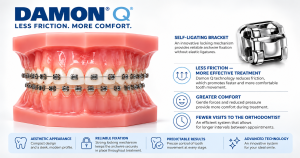
Before comparing the systems, it is worth examining the mechanism behind Damon Q. Unlike traditional ligated designs that secure the archwire with elastic bands or wire ties, this system utilizes the SpinTek sliding mechanism, which is integrated directly into the bracket body:
| Characteristics | Description |
| The functioning principle | The archwire sits loosely within the 0.022-inch bracket slot and is secured by a special cap without additional tightening. This reduces friction during tooth movement along the archwire. |
| The absence of ligatures | The design does not require elastic or metal ligatures. As a result, less plaque accumulates around the brackets, and oral hygiene is made easier. |
| The peculiarities of the construction | The all-metal body, featuring four slot walls and a low profile, ensures secure archwire engagement, improves control over tooth rotation, and facilitates more precise movement. |
| SpinTek technology | The SpinTek passive latch opens using a special tool and transfers opposing forces to the bracket body rather than to the periodontal tissues, thereby increasing comfort during system activation. |
In addition to their locking mechanism, Damon Q self-ligating brackets feature a color-coded positioning system. Green, blue, and red indicators correspond to low, standard, and high torque (buccolingual tooth inclination), allowing the orthodontist to select the appropriate prescription — a set of parameters built into the bracket to control tooth position and movement — based on the specific clinical situation.
Advantages of Damon Q
The technical features incorporated into the system’s design directly influence the course of treatment. The advantages outlined below are supported by research and the manufacturer’s technical documentation.
- Reduced Discomfort. The SpinTek locking mechanism directs opposing forces onto the bracket itself, reducing peak mechanical stress compared to the tightening of elastic ligatures. Patients who have previously undergone treatment with traditional ligature-based systems — and can thus compare the sensations associated with archwire changes in both designs—notice the reduced pressure during routine procedures.
- Easier Maintenance. The absence of elastic O-ring ligatures eliminates the areas where dental plaque and bacterial biofilm most frequently accumulate. Oral hygiene is simplified to brushing with a medium-bristle toothbrush and using an oral irrigator, without the need to remove elastic rings; this reduces the risk of cavities and enamel demineralization around the bracket while the appliance is being worn.
- Fewer follow-up visits. A clinical study comparing two patient groups found that the average number of follow-up visits was 13.4 for the self-ligating bracket group compared to 17.2 for the conventional bracket group, while the average appointment time decreased from 19.1 to 13.9 minutes. A lower visit frequency is convenient for patients who combine treatment with work or studies abroad and cannot easily take time off to visit the orthodontist’s office.
- Efficient tooth movement. In the same study, the average duration of active treatment was 15.8 months for the Damon Q group versus 19.4 months for the conventional bracket group (statistically significant at p<0.001). It is worth noting that results from individual studies vary depending on the complexity of the clinical case and patient compliance; therefore, the orthodontist determines the final treatment duration following diagnosis.
- Durability of the metal structure. The Damon Q bracket features an all-metal body with four walls and a precision-engineered slot depth, which enhances control over tooth rotation. This design withstands the mechanical forces of chewing and does not require frequent replacement of attachment components during the course of treatment, even during a prolonged active phase.
Damon Q or standard metal braces?
To evaluate the difference between the systems in practice, it is worth comparing the key treatment parameters:
| Characteristics | Damon Q | Classic ligature braces |
| The type of system | Passive self-ligation | Ligature system |
| Archwire fixation | SpinTek latch | Elastic or metal ligature |
| Friction between the archwire and the slot | Lower | Higher |
| Hygiene | Fewer plaque-retention areas | More plaque-retention areas |
| Average duration of the reception | Around 13,9 minutes | Around 19,1 minutes |
| Average number of visits | 13,4 | 17,2 |
| Changing of ligatures | Not necessary | Necessary |
| Teeth rotation control | High | High |
| Material | Medical-grade stainless steel | Metal or ceramic, depending on the model |
Despite their differences, both systems can achieve comparable clinical results, provided there is an accurate diagnosis and adherence to the treatment plan. The orthodontist discusses the choice of appliance with the patient during the consultation, taking into account the budget, the complexity of the case, and aesthetic preferences regarding the appearance of the braces.
Damon Q or aligners?
Patients considering orthodontic treatment often choose between Damon Q braces and aligners. Both systems are designed to correct bite issues and align teeth, yet they differ in their operating principles, wear requirements, and clinical capabilities. To better understand the features of each method, let us compare them based on key criteria:
| Criterion | Damon Q | Aligners |
| The type of construction | Non-removable bracket system | Removable transparent mouthpieces |
| Visibility on the teeth | Noticeable, yet with a compact profile | Almost imperceptible |
| Patient’s discipline | Does not depend on how regularly it is worn | Requires wearing for 20-22 hours a day |
| Complex clinical cases | Suitable for mild, moderate, and complex bite abnormalities | Most effective in mild to moderate cases |
| Teeth movement control | High mechanical control in three planes | It depends on the clinical situation and adherence to recommendations |
| Teeth rotation correction | High efficiency | May require additional elements |
| Vertical teeth movement | Well-prognosed | May be limited in complex cases |
| Oral cavity hygiene | Requires thorough care around the braces | The aligners can be removed while brushing your teeth |
| Dietary restrictions | Hard and sticky foods should be avoided | Mouthpieces are removed when eating |
| Adaptation comfort | An adjustment period is needed for braces | Usually easier adaptation |
| Risk of treatment protocol violation | Minimal, since the system is fixed | Higher due to the possibility of irregular wear |
| Suitable for teenagers | Yes | Yes, but it requires a high level of discipline |
| Suitable for adults | Yes | Yes, especially if the aesthetics of the treatment are important |
A final decision is made following an in-person examination and analysis of diagnostic images, as both approaches have clinical limitations that cannot be assessed remotely.
Who are Damon Q braces suitable for?
The list of clinical indications for the system is extensive and applies to both children and adults:
- Dental crowding. The bracket system evenly distributes teeth within the dental arch, creating space without the need for tooth extraction in mild to moderate cases.
- Gaps between teeth. Diastemas (gaps between adjacent teeth) are eliminated by gradually bringing the roots closer together through controlled archwire pressure.
- Malocclusion. The system corrects the relationship between the upper and lower dental arches in cases of distal, mesial, or open bite.
- Relapse after previous treatment. The system is used for re-correction in cases where teeth have partially shifted following the completion of an earlier orthodontic course.
- Adult treatment. In 2024, orthodontists in Canada and the USA treated approximately 1.9 million adult patients — an increase of 300,000 compared to 2022.
Adult bone remodels more slowly, meaning tooth movement takes longer; however, the result remains stable provided the retention protocol is followed. The final determination of indications remains the prerogative of the orthodontist, who assesses the condition of the dentofacial system based on imaging and a clinical examination.
What does the Damon Q bracket placement process involve?
Placing Damon Q brackets is a multi-stage process that begins with comprehensive diagnostics and concludes with a retention period once the planned result has been achieved. At each stage, the orthodontist monitors tooth movement, adjusts system parameters, and evaluates treatment progress.
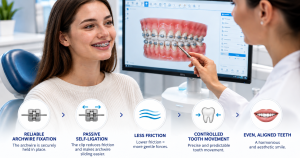
Stage 1 — Orthodontic consultation
The doctor examines the dentition, assesses the bite according to Angle’s classification, and determines the preliminary suitability of the Damon Q system for the specific clinical case, while also checking for contraindications and concurrent dental conditions.
Stage 2 — Diagnostics
Following the initial examination, the patient undergoes comprehensive orthodontic diagnostics. The goal is to determine the type and severity of the malocclusion, assess the condition of the teeth, roots, and bone tissue, and gather data to create an individualized treatment plan:
- CT (computed tomography of the maxillofacial region) allows for the assessment of bone tissue condition and root positioning, as well as the determination of alveolar bone volume;
- A photographic record captures the initial state of the face and dentition for subsequent comparison of treatment results;
- Digital scanning creates a 3D model of the dentition, eliminating the need for traditional impressions.
The collected data enable the orthodontist to form an objective picture of the clinical case before treatment begins and to model the projected outcome.
Stage 3 — Treatment plan
Based on the diagnostic data, the doctor develops an individualized tooth movement strategy and determines the estimated duration of the course and the sequence of orthodontic archwires—ranging from thin nickel-titanium wires in the initial stage to stiffer steel wires in the final stage.
Stage 4 — Placement of Damon Q braces
The doctor bonds the braces to the tooth surfaces using composite adhesive, after which the initial working archwire is inserted into the slots. The procedure typically takes 60 to 90 minutes, depending on the number of teeth and the complexity of the clinical case.
Stage 5 — Follow-up visits
The orthodontist examines the patient every 6-10 weeks, replaces the archwire with the next one in the force-calibration sequence, monitors tooth movement progress, and adjusts the treatment plan if necessary.
Stage 6 — Retention period
After the braces are removed, the teeth are stabilized in their new position using retainers—either removable or fixed appliances. A classic study by the University of Washington in Seattle showed that among patients who wore retainers for only 1–2 years after active treatment ended, 70% required further correction ten years later. The duration of the retention period is determined individually by the orthodontist, but it generally corresponds to the length of the active treatment phase.
Is wearing Damon Q braces painful?
Most patients considering orthodontic treatment wonder how painful wearing braces will be. In reality, the placement of the Damon Q system is painless; however, temporary discomfort may occur during the first few days after an archwire adjustment. The intensity of this discomfort depends on individual sensitivity, the complexity of the clinical case, and the stage of treatment:
- Adaptation period. During the first 3-5 days after braces are fitted, as well as for 1-2 days following scheduled adjustments, patients may experience moderate pressure on their teeth or slight discomfort while chewing. These sensations are a normal tissue response to controlled orthodontic force and gradually subside as the patient adapts.
- Features of the self-ligating system. Damon Q utilizes a passive self-ligation mechanism that does not require elastic ligatures. When the archwire is replaced or activated, the bracket’s locking mechanism transfers force to the bracket body rather than creating additional pressure through the tightening of ligatures, making the procedure more comfortable for the patient.
- Level of discomfort. Data from a systematic review of clinical studies indicate no statistically significant difference in pain intensity between self-ligating and traditional braces. However, the use of light orthodontic archwires and reduced friction within the Damon system facilitates a smooth transfer of force to the teeth and periodontal tissues.
- Managing discomfort. If significant discomfort arises after the braces are fitted, the doctor may recommend a soft diet for a few days and, if necessary, safe pain relief medication. In most cases, discomfort decreases substantially within the first week.
For the vast majority of patients, wearing Damon Q is not associated with pain. Once the adjustment period is over, the braces hardly interfere with daily life, and follow-up visits are comfortable.
Treatment Results
The conclusion of the active phase brings visible and functional changes to the dentofacial system:
- Straight teeth. Tooth crowns align properly within the dental arch, free from significant rotations or tilting.
- Correct bite. The upper and lower dental arches meet according to anatomical norms, reducing strain on the temporomandibular joint.
- A harmonious smile. Symmetrical tooth positioning and the absence of gaps create a natural, aesthetic result.
- Improved chewing function. Even distribution of chewing forces reduces the risk of excessive wear on specific teeth and overloading particular areas of the dental arch.
The stability of the result depends on adherence to the retention protocol; therefore, the orthodontist instructs the patient on wearing retainers before the braces are even removed, explaining the potential risks of recommendations’ non-compliance.
Why do patients choose Astra Dent Warsaw?
The success of orthodontic treatment depends on the quality of diagnostics, the doctor’s expertise, and the possibilities of dentistry. Therefore, when choosing an orthodontic center, one should consider the level of equipment, the approach to treatment planning, and the availability of modern technologies.
Advantages of bite correction at Astra Dent:
- Experienced orthodontists. The center’s doctors undergo annual professional development and work with modern bracket systems, including Damon Q.
- Modern digital diagnostics. Astra Dent specialists use CT scans, digital scanners, and photographic documentation for precise treatment planning before the appliance is even fitted.
- English-speaking team. Patients receive consultations in their native language, ensuring no language barriers at any stage of treatment.
- Comprehensive treatment in one place. In addition to orthodontics, related dental services are available at Astra Dent. This allows for oral preparation prior to fitting braces without the need to visit outside specialists.
- Transparent financial plan. The cost of treatment is agreed upon during the consultation, with all stages outlined in a written plan—no hidden fees.
- No queues. Appointments are scheduled for specific times, eliminating long waits in the reception area.
- City center location. The location makes it convenient for patients working or studying in Warsaw to attend follow-up visits.
Combining clinical expertise with digital diagnostic technologies allows for a more accurate prediction of treatment duration right from the initial consultation, helping to avoid unexpected adjustments to the treatment plan.
How can I book an appointment at Astra Dent Warsaw?
You can schedule a consultation for Damon Q braces using one of the following convenient methods:
- phone: +48 533 599 552;
- e-mail: info@astradent.pl;
- online form on the Astra Dent website.
A specialist from the center will contact you to confirm the consultation time and advise you on any necessary documents or X-rays—such as those obtained during previous visits to other specialists.